A private jet company doesn’t need to operate its own vehicles, but it should be able to arrange ground transportation as part of the journey. In Greater Boston, private aviation ground transportation depends on more than a scheduled landing: pickup arrangements need to reflect flight updates, the correct FBO, passenger and luggage details, and the preferred handoff.
That coordination matters. Arrival times can shift, and the pickup may be at the aircraft or inside the FBO, depending on access and the trip plan. A smooth handoff starts with clear information shared between the flight team and chauffeur.
If you’re arranging a private jet arrival or departure, this guide explains what details to provide, how schedule changes affect pickup timing, and how to plan for luggage, child car seats, and vehicle choice. It also explains the difference between planeside and FBO lobby pickup, helping you set expectations and arrange ground transportation that fits your itinerary.
Key Takeaways
- Choose a pre-arranged chauffeur when coordinated pickup timing, privacy, and a defined destination matter more than on-demand flexibility.
- Share flight updates with the transportation team so pickup timing can adapt if the aircraft arrives early or late.
- Match the vehicle to the passenger group, luggage volume, oversized items, and any child car-seat needs.
- Clarify whether the pickup is planeside or inside the FBO, since access and procedures can shape the handoff.
- For Greater Boston arrivals, provide the exact FBO and pickup details to help the chauffeur reach the right location.
Should my private jet company provide ground transportation as well?
A private jet company can coordinate a ground transportation partner without operating its own vehicles. The key is aligning the aircraft schedule, pickup location, passenger needs, and destination.
Rideshare and Chauffeur Options
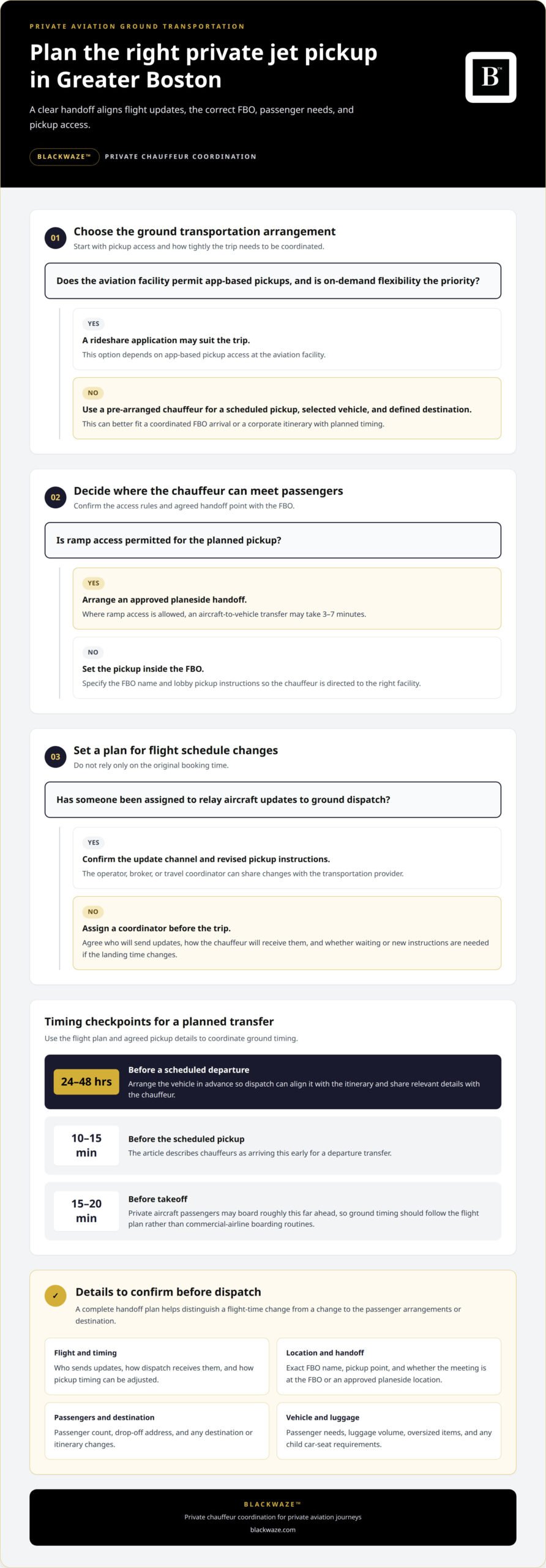
Rideshare applications may suit passengers seeking an on-demand ride when the aviation facility permits app-based pickups. But access varies, so this option may not suit an FBO arrival or a tightly coordinated corporate itinerary. A pre-arranged chauffeur provides a scheduled pickup, a selected vehicle, and a defined destination.
Unlike an airline airport transfer, private aviation ground transportation is coordinated around the aircraft and its FBO, not a commercial terminal’s passenger flow. Services can include point-to-point transfers, hourly chauffeur bookings, executive vehicles, and coordinated luggage transport. Choose based on pickup access, passenger count, luggage, timing, and whether you need a direct handoff.
Private jet companies may arrange ground transportation for passengers, but the scope varies by provider and location. For a scheduled departure, arrange the vehicle 24 to 48 hours before the flight. This gives dispatch time to align the pickup with the itinerary and share relevant details with the chauffeur.
Ground partner standards may include $5-10 million in commercial liability insurance, FBO pre-clearance for chauffeurs, and FBI-level background checks. These measures support access coordination and passenger security. Confirming the FBO name, pickup point, and passenger details also helps prevent a chauffeur from waiting at the wrong facility.
Door-to-Door Chauffeur Transfers
A door-to-door arrangement connects a home, hotel, or office with the private aviation terminal, then links the aircraft arrival to the onward destination. The coordinator aligns the pickup time, passenger count, luggage volume, and drop-off address. If ramp access is permitted, the vehicle may meet passengers planeside; otherwise, the chauffeur can meet them at the FBO.
For a departure transfer, chauffeurs are described as arriving 10-15 minutes before the scheduled pickup. Private aircraft passengers may board roughly 15-20 minutes before takeoff, so ground timing should follow the flight plan rather than a commercial airline’s boarding routine. Where ramp access is allowed, aircraft-to-vehicle transfers may take 3-7 minutes.
In the United States, transportation cost depends on the route, vehicle, timing, and service scope. A quote is based on those trip details.
To coordinate an early or delayed arrival, the flight team or broker can relay aircraft status to ground dispatch and adjust the destination pickup time. Dispatch that monitors an aircraft by its registration can respond without relying only on a passenger’s phone. This helps the chauffeur adapt to schedule changes while keeping the handoff plan clear.
Do you monitor private flight schedule changes?
Pickup coordination should take account of updates from the aircraft operator, not just the original booking time. Confirm who will share flight updates and how the chauffeur will receive revised arrival details.
Delay and Early Arrival Pickup Changes
A private flight’s schedule can shift after the car is arranged. If the estimated arrival time changes, the operator or flight team should relay updates to the person coordinating ground transportation. Confirm whether and how the pickup time can be adjusted, and whether the chauffeur can wait or needs new instructions.
If passengers are running late, the travel coordinator can contact the car company and aircraft operator to discuss adjusting the destination pickup. Early arrivals also require clear communication: contact the destination car company to ask whether the chauffeur can accommodate the changed schedule. This coordination can be useful when passengers have a fixed onward meeting.
For a private jet charter, clarify who will send flight updates and which channel the transportation provider will use to receive them. Include the passenger’s destination and pickup instructions in the booking, so a time adjustment doesn’t leave the chauffeur without essential details. Agree on waiting arrangements in advance, particularly if the landing time changes while the vehicle is positioned.
Flight Updates and Pickup Procedures
Effective flight coordination depends on a defined handoff. The operator, broker, or designated travel coordinator should share schedule changes with the transportation provider. Confirm how the chauffeur will receive any revised arrival details and the agreed pickup point, whether that’s an FBO lobby or an approved planeside location.
Pickup instructions should specify the location and time, passenger count, and drop-off address. These details give the chauffeur a practical plan if the arrival shifts. They also help distinguish a flight-time change from a change in destination or passenger arrangements.
Flight coordination can also support in-flight requests. Private jet companies may offer catering and menu options, with services varying by company and package. Passengers may bring personalized food items. Sharing preferences with the flight team before departure helps keep catering arrangements separate from the chauffeur’s pickup details.
For a corporate itinerary with several stops, an hourly booking can provide a planned vehicle schedule beyond the airport transfer. The chauffeur’s pickup and waiting instructions should reflect the latest flight information and next appointment, not just the original landing estimate.
Arrange a chauffeur booking with flight timing and pickup details in mind.
Passenger, luggage, and child car-seat details
To arrange a private jet airport transfer, provide the flight details, exact FBO, pickup point, destination, passenger count, and luggage volume. Include oversized items such as golf clubs or ski equipment, as well as any child car-seat requirements and special requests.
Passenger numbers alone don’t determine the right vehicle. A sedan is typically suited to 1-3 passengers, while premium SUVs are listed for 3-6. Executive vans can accommodate 6-14 passengers. These capacities are planning guides, not a substitute for checking how the group’s bags fit alongside its seats.
For example, three passengers with several large suitcases may need a different vehicle configuration from three passengers carrying only briefcases. Include the number of bags and their approximate size in the booking. List strollers, instrument cases, sporting equipment, and other oversized pieces separately, as they affect available luggage space.
A separate luggage-only vehicle requires advance quotation, approval, and confirmation. The arrangement depends on availability and may involve additional charges. Share the luggage count and dimensions early, especially when passengers and baggage need separate transportation from an airport or FBO.
Include child car-seat planning in the initial request. State how many children will travel, their ages, and the seat type required. This gives the transportation coordinator specific information for arranging the vehicle. Don’t assume a seat can be added at pickup; include the requirement in the original itinerary.
Passengers may also request amenities or other special services. Private jet companies can offer options such as in-flight catering, decorations, or entertainment accommodations, though arrangements vary by company and package. Ask the flight team to record preferences, then share ground transportation requests separately, such as space for mobility equipment or a scheduled stop.
Accurate passenger and baggage information is especially useful when flight schedules change. If a passenger joins the trip, a bag is added, or the destination changes, the coordinator can update the vehicle plan alongside the revised schedule. A corporate group, for instance, should keep its passenger manifest and luggage count current rather than rely on an earlier estimate.
For a family arriving with checked bags, a stroller, and a child seat requirement, the coordinator needs the full picture before assigning a vehicle. Clear details support a suitable choice, a practical loading plan, and an orderly transfer from the aircraft to the final destination.
Planeside pickup versus FBO lobby pickup
Car services experienced with private aviation coordinate pickups through the FBO and aircraft operator. The right arrangement depends on ramp access: passengers may meet the vehicle beside the aircraft or inside the FBO lounge.
With planeside pickup, the vehicle waits near the aircraft after landing, allowing passengers to board without first entering the terminal. This option depends on airport access and FBO arrangements, so coordinate it before arrival. For a private charter, the flight team and ground dispatch should align the pickup point with the FBO and aircraft arrival plan.
A planeside meet and greet can suit passengers who want a direct handoff from aircraft to car. Communicate the chauffeur’s location clearly, particularly when several aircraft or operators use the same facility. For international arrivals, the plan should also specify whether passengers will meet the chauffeur at the aircraft or proceed through the FBO first.
Ramp access isn’t available for every pickup. Do not assume a broker or chauffeur service can arrange access. Confirm the applicable procedures and permissions directly with the FBO and aircraft operator before making a planeside request. Make the pickup point part of the booking rather than assuming it can be arranged after landing.
When ramp access isn’t available, passengers are escorted to the FBO. The chauffeur can meet them in the lounge, assist with bags, and escort them to the vehicle. Lobby pickup offers a clear alternative when the car cannot reach the aircraft. Specify the FBO and intended meeting point inside it in the pickup instructions.
At Miami Opa-locka Executive Airport (OPF), confirm the pickup arrangements and meeting point directly with the FBO and aircraft operator. The same applies to departures: the agreed handoff point determines where passengers meet the chauffeur before continuing to the aircraft.
To coordinate the handoff, give transportation dispatch the exact FBO and, when available, its gate or door assignment. The flight team can share aircraft status and passenger details with dispatch. This helps the chauffeur follow the agreed procedure, whether the pickup is planeside or inside the lounge.
For private aviation ground transportation, choose a car service that can coordinate a pre-arranged chauffeur pickup with the FBO and flight team. Before booking, clarify the intended meeting point and how the operator’s ramp-access procedures affect the arrival or departure plan.
Private aviation ground transportation
When arranging ground transportation after a private flight, identify the exact FBO, not just the airport. An airport may have several FBOs, so a chauffeur sent to the wrong facility can miss the handoff. Include the FBO name, arrival or departure time, passenger count, and destination in the transfer itinerary.
Confirm how aircraft status updates will reach the transportation coordinator. This matters when a private flight’s arrival changes while passengers are traveling. The flight coordinator can relay updates to dispatch, which can adjust the vehicle’s arrival and share the revised pickup plan with the chauffeur.
Confirm the meeting point in the FBO plan. If ramp access is permitted, the vehicle may meet passengers planeside. Otherwise, the chauffeur can meet them inside the FBO, assist with luggage, and escort them to the car. The FBO name and, when available, gate or door assignment help define the handoff.
Choose a vehicle for the complete itinerary, not just the number of travelers. Passenger count, luggage volume, and oversized items determine the practical fit. For example, a group with golf clubs or ski equipment may need more luggage capacity than a group carrying briefcases.
A broker can coordinate the ground leg with the flight operator and destination car service. Share the passenger manifest, luggage details, destination address, and schedule changes through the designated coordinator. For a multi-stop corporate itinerary, include each destination and the planned sequence so dispatch can arrange the transfer around the full journey, not just the aircraft arrival.
Cost presentation can vary by preference and local market availability. Ground transportation may be itemized separately from other private-jet travel costs. The vehicle type, route, and requested service shape the arrangement, while the broker or transportation coordinator can show how the ground leg fits into the overall itinerary.
The practical takeaway is straightforward: identify the exact FBO, confirm how aircraft status updates will be shared, and match the vehicle to passengers and baggage. These details help create a more seamless transition from aircraft to destination, whether the trip ends at a residence, hotel, or business address. Arrange private chauffeur transportation for your itinerary.
BLACKWAZE™
BLACKWAZE™ provides premium private chauffeur transportation for travellers planning airport journeys, business schedules, and onward travel. When requesting service, share your pickup location, flight details, passenger count, luggage needs, and destination. These details help shape transportation around your itinerary. Chauffeur service is pre-arranged and private, not a taxi or rideshare request.
For a journey involving multiple stops or meetings, include the schedule and any timing considerations with your request. If you are arranging transportation after a private jet journey, provide the relevant pickup details so they can be considered as part of your travel plans.
Explore online booking with BLACKWAZE™ to arrange the next step for your trip.
Plan the Ground Leg Around the Journey
Private aviation ground transportation works best as part of the itinerary, not as an afterthought. Before finalizing your trip, decide who will coordinate the ground leg, how flight updates will reach dispatch, and which details passengers need to provide. One planning conversation can bring the flight team, chauffeur, and destination into a clear sequence.
Include ground arrangements in the same itinerary as the private flight. This gives passengers and coordinators a shared reference if plans shift and helps make each handoff deliberate rather than improvised. The result is a journey designed around the traveler’s priorities, from departure through arrival.
BLACKWAZE™ supports private travel with chauffeur transportation tailored to airport, business, and multi-stop itineraries. For a transfer or a more extended schedule, start with your journey details and choose the service format that fits.
Plan your next journey with BLACKWAZE™ and take the next step toward a composed, well-coordinated trip.
Frequently Asked Questions
Can the chauffeur meet passengers planeside?
Yes, when the airport and FBO permit vehicle access to the ramp. A planeside handoff lets passengers board near the aircraft after landing, but it isn’t a standard procedure at every airport. At Miami International Airport, tarmac meets aren’t standard and are rarely available on short notice. Include your preferred handoff in the trip plan rather than assuming it comes with a private flight.
How can a chauffeur service arrange a private jet airport car transfer?
A transfer can be arranged from the flight itinerary before every aircraft detail is finalized. For example, the aircraft’s tail number may not be confirmed until a few hours before departure. The transportation coordinator can add that update to the existing trip plan. Share changes to the destination or onward schedule through the same coordinator so the ground booking reflects the current journey.
Can private jet passengers be picked up directly on the airport ramp?
Yes, direct ramp pickup is possible where the airport and FBO permit it. The vehicle can wait beside the aircraft for passengers to board after landing. This is different from a planeside greeting without vehicle access to the ramp. Access depends on the facility and its operator, so the aircraft’s arrival location alone doesn’t determine where a car may wait.
How far in advance should private jet ground transportation be booked?
Arrange private aviation car service 24 to 48 hours before the scheduled departure. This advance window is useful for planned trips with a fixed itinerary. If the aircraft details are still developing, the later tail-number update can be added to the transportation plan. For a trip with changing destinations, send revised itinerary information through the booking coordinator rather than relying on the original schedule.
What are the safety and insurance considerations for private aviation car services?
Assess insurance coverage and chauffeur screening as separate considerations. Commercial liability insurance addresses the ground partner’s coverage, while background checks and FBO pre-clearance relate to chauffeur screening and facility access. Private aviation ground partners are described as carrying $5-10 million in commercial liability insurance. These standards provide useful context for evaluating how a ground arrangement addresses coverage and access.
How do ground transportation options vary by airport and FBO?
Options depend on the facility’s access procedures and vehicles available in its local market. Some private aviation facilities permit standard rideshare applications, while others don’t. Remote destinations may also have fewer high-end vehicle choices than major metropolitan areas. For itineraries involving several airports, plan each ground leg around its destination rather than assuming one pickup method or vehicle will suit every stop.