
Insurance alone does not determine who is responsible when an executive journey goes wrong. A clear executive chauffeur duty of care requires understanding the coverage in place, how liability is handled, and what happens when a safety incident is reported.
It is reasonable to expect more than a general assurance that a service is insured. Request clear, written information about commercial auto and passenger coverage, applicable limits, and how claims or incidents are managed. This guide explains what to ask for and how to assess the response.
It also covers the safety practices that matter before and during a journey, from driving competence and professional conduct to privacy and chauffeur screening. Use this practical framework to evaluate executive ground transportation for business trips, airport transfers, and other travel, without mistaking polished service for documented safeguards.
Key Takeaways
- Look for clear traveller identification and meet-and-greet procedures that help the passenger locate the assigned chauffeur and vehicle.
- Request written details of commercial auto liability and passenger coverage, including applicable limits and how incidents or claims are handled.
- Assess driving competence through the provider’s safety practices, route planning, and approach to professional conduct on the road.
- Set expectations for discretion, passenger privacy, and the careful handling of itinerary and personal information.
- Review how chauffeurs are screened, including background checks and driving-history reviews, as part of a consistent safety process.
1. What reporting should a duty-of-care ground program produce?
An employer’s duty of care includes taking reasonable steps to protect employees while they travel for work. A ground transportation program should create a clear record of each journey, from assignment and arrival through completion. That record helps a travel manager confirm who was transported, whether the trip followed policy, and how the service responded to an incident.
Before pickup, provide the traveller with the chauffeur’s name and photograph, along with the vehicle details. At an airport, a named-board meet-and-greet inside the arrivals area helps the employee identify the assigned pickup and avoid accepting unlicensed transport. The report should record when those details were sent and where the meeting point was set.
Vehicle inspection and maintenance records are also part of a responsible ground transportation program. A chauffeur service should maintain vehicles on a documented schedule and retain inspection and compliance records in line with local regulations. These records show that vehicle checks are ongoing, not performed only after a problem.
Useful journey reporting links each booking to its business purpose. Record the passenger, date, pickup and destination, booking reference, and approved cost centre. A centralized invoice can then be matched against travel policy, such as an authorized airport transfer or a journey between a hotel and a meeting. Document policy exceptions, including the reason and approval, so finance teams can review them without reconstructing the trip.
Itinerary details should support coordination without exposing unnecessary personal information. Include the scheduled pickup location, destination, relevant flight or meeting details, passenger count, luggage needs, and a designated corporate contact. For a multi-stop itinerary, record each leg and any approved changes. This lets a travel manager compare the transport provided with the planned schedule.
Confidentiality matters throughout the process. Limit access to itinerary and passenger data to people who need it to arrange, perform, or oversee the journey. Keep sensitive meeting topics and personal notes out of routine booking fields. Use a defined retention and incident-reporting process, and record who received each report and when.
When an incident occurs, the provider should log and investigate it, then report its findings to the client contact. A useful report records the time, location, people involved, immediate actions, and follow-up steps. Keep the details factual. Clear reporting helps the employer review the response and improve future travel arrangements.
For corporate travel, consistent booking, reporting, and policy controls support a more coordinated ground program. A corporate transportation program can bring journey records and approvals into a clearer workflow, helping travel teams perform timely reviews while protecting employee privacy.
2. How should insurance and liability be handled, and what should I request?
Chauffeur requirements vary by state, city, and country because licensing and insurance rules are local. A transportation company should meet the requirements in each jurisdiction where it operates. For a corporate reservation, request documentation identifying the operating entity, vehicle, and relevant coverage territory.
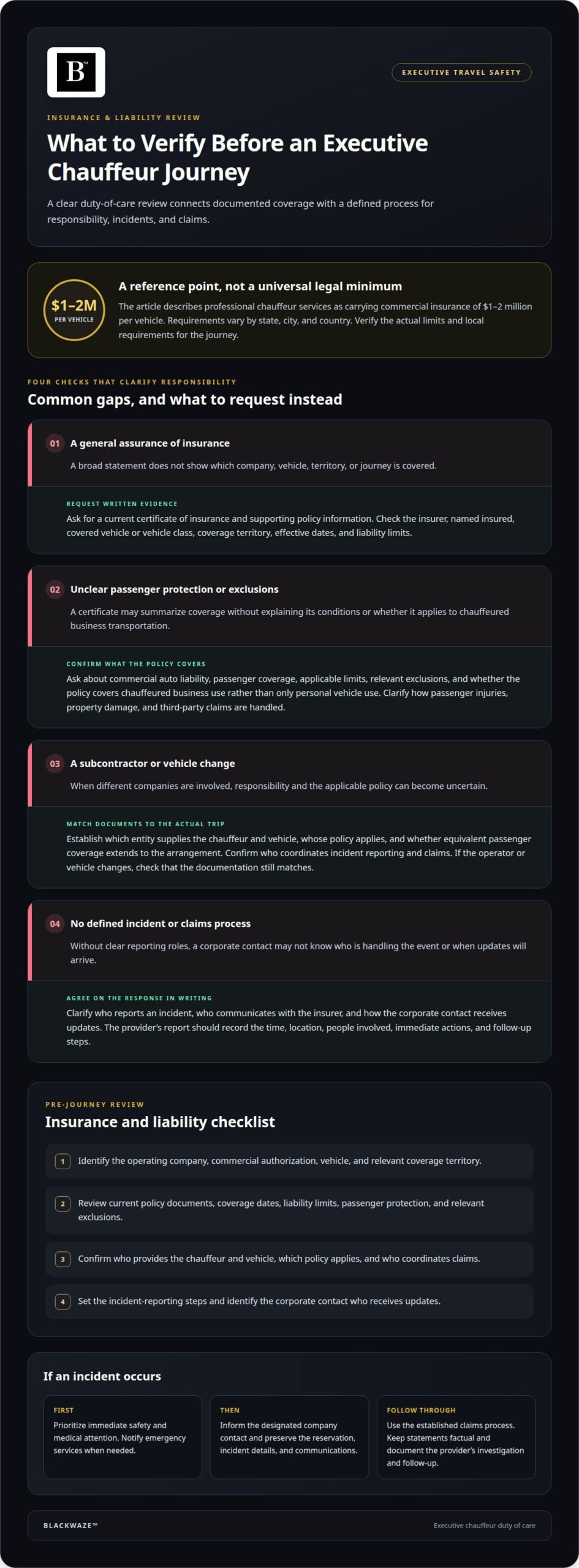
Professional chauffeur services carry commercial insurance of $1-2 million per vehicle. Treat that figure as a reference point, not a universal legal minimum. Ask for the commercial auto liability limit, passenger coverage, policy period, and any relevant exclusions. Confirm that the policy covers chauffeured business transportation, not only personal vehicle use.
Request a current certificate of insurance and supporting policy information for the service involved. The documents should identify the insurer, named insured, covered vehicle or vehicle class, effective dates, and liability limits. Ask how passenger injuries, property damage, and third-party claims are handled. Clear answers help a travel manager understand the coverage before a journey begins.
Connect commercial licensing and insurance checks. Confirm that the operating company and vehicle meet local commercial requirements, then establish who is responsible for the booking and any claim. A certificate may summarize coverage without explaining every condition. For executive chauffeur duty of care, a written process should clarify who reports an incident, who communicates with the insurer, and how the corporate contact receives updates.
Subcontractors and third-party vehicles can create uncertainty when responsibility is divided between companies. Before booking, establish which entity supplies the chauffeur and vehicle, whose policy applies, and whether equivalent passenger coverage extends to that arrangement. The agreement should identify who handles incident reporting and claims coordination. If the assigned vehicle or operator changes, the documentation should still match the actual trip.
After a chauffeur accident or passenger injury, prioritize immediate safety and medical attention. Notify emergency services when needed, inform the designated company contact, and preserve relevant records, including the reservation, incident details, and communications. The transportation provider should document and investigate the event, then report it to the client contact. Keep statements factual and follow the established claims process.
For each reservation, a concise insurance review can cover the operating company, commercial authorization, vehicle coverage, passenger protection, applicable limits, policy dates, and claims contact. This gives corporate travel teams a practical basis for assessing liability without assuming one document answers every question. It also ensures the review matches the journey’s location and the vehicle assigned.
Licensing and insurance requirements are local, so the applicable rules depend on where the service operates. Verify that the company and vehicle meet the requirements for the trip’s jurisdiction, and clarify who handles incident reporting and claims.
3. Driving skills and safety knowledge
A professional driver needs sound vehicle control, traffic awareness, and judgment under pressure. Assess whether training covers defensive driving, safe following distances, passenger assistance, and calm responses to route changes. Driver competence is a practical part of ground travel risk management.
An employer’s duty of care remains relevant whether a passenger chooses a taxi, rideshare, or executive chauffeur. Specific legal responsibilities depend on the jurisdiction and circumstances, but employers still need to take reasonable steps for work travel. A pre-arranged chauffeur journey can support oversight with advance chauffeur details, a defined pickup, and a documented incident process.
Safety knowledge extends beyond steering and navigation. A chauffeur needs to recognize fatigue, adapt to weather and traffic, choose a safe stopping point, and avoid rushing to keep to a schedule. For airport transfers, the chauffeur should follow the agreed pickup procedure and communicate delays through the designated channel. A reliable record can document route changes, delays, and safety-related decisions.
Passenger security also depends on professional judgment. The chauffeur should discreetly confirm the correct passenger, assist with entry and exit, and avoid sharing itinerary details with anyone outside the trip. If a passenger feels unwell or raises a concern, the chauffeur should stop in a suitable safe location and follow the company’s incident process. Clear procedures matter more than a polished manner alone.
COVID-19 procedures should reflect current public health guidance and the rules that apply where the trip takes place. A written protocol can explain vehicle cleaning between journeys, access to hand-cleaning supplies, and how a passenger can communicate a health-related concern. The driver should know the procedure before pickup, rather than improvising during travel. Policies also need review when local guidance changes.
Useful safety checks include reviewing the chauffeur’s training, confirming familiarity with the planned route, and recording required vehicle-readiness checks before dispatch. For a multi-stop itinerary, allow time between meetings rather than encouraging unsafe driving to make up delays. A travel manager can review recurring route issues or incident reports and adjust future ground arrangements.
These measures make chauffeur safety assessable through observable practices, not broad assurances. A planned journey can be arranged through online booking, with its pickup details and itinerary defined in advance.
4. Professionalism, discretion, and privacy
Professional conduct is visible in small, consistent actions. A chauffeur confirms the passenger discreetly, uses the agreed form of address, and handles luggage with care. During business travel, the chauffeur avoids personal questions and does not discuss a passenger’s meetings, destination, or schedule with others. These standards help make private ground transportation suitable for corporate travel.
Airport pickups need a clear handoff. For a commercial terminal, specify the agreed meeting point and passenger identification method in the booking. At a private aviation terminal, the pickup plan should reflect the arrival location and any arrangements made with the passenger or travel coordinator. The chauffeur follows those instructions and avoids displaying a passenger’s name publicly unless the plan calls for it.
Good communication is precise, not intrusive. A chauffeur can send the agreed arrival update and vehicle description through the approved channel, then limit further messages to operational needs. A delayed passenger, for example, needs a concise update about the pickup location, not a message repeating sensitive itinerary details. The corporate travel contact should have a defined way to receive relevant service updates.
Privacy starts with the booking record. Collect only the details needed to perform the journey, such as the passenger’s name, pickup point, destination, and essential accessibility or luggage information. Restrict access to staff arranging or supporting that booking. Keep confidential meeting topics, account information, and personal notes out of routine itinerary fields.
Careful information handling also means controlling how details are shared. Send itineraries only to authorized recipients, use approved business communication channels, and avoid leaving printed schedules visible in the vehicle. After a trip, retain booking and incident records according to the organization’s established process. A travel coordinator should know who can access those records and how requests for passenger information are handled.
Discretion applies inside the vehicle, too. The chauffeur should not listen to or join private calls, photograph passengers, or share journey details socially. If a passenger asks for a quiet cabin, the chauffeur can acknowledge the request and limit conversation. Confirm any route or pickup change with the passenger or an authorized contact.
For a corporate airport journey, a well-prepared booking connects the pickup plan, passenger communication, and privacy expectations before arrival. Clear instructions reduce uncertainty at the terminal while keeping sensitive details on a need-to-know basis. A coordinated executive airport transfer can make that handoff easier to manage across a busy travel itinerary.
5. Chauffeur background and driving-history screening
Screening should establish whether a chauffeur is suitable to carry passengers professionally. A provider should screen chauffeurs assigned to client journeys and review their driving histories. A clean driving record over multiple years is an important standard for professional chauffeur drivers, alongside a current ability to perform the role safely and courteously.
Ask what the screening process covers, how often driving records are reviewed, and how the provider responds to new concerns. The process should use clear criteria, consistent documentation, and a defined way to remove a chauffeur from assignments when needed. These controls make chauffeur screening an operational practice, not just a one-time hiring form.
A driving-history review can reveal patterns that a single licence check may miss. Repeated moving violations, suspensions, or serious incidents, for example, may call for further assessment under the provider’s policies. Decisions should follow consistent criteria and applicable local rules. A corporate travel manager can request a summary of the screening standards without needing a chauffeur’s private personnel file.
Background screening requires careful handling. The provider’s process should explain which checks it conducts, how identity is established, and how sensitive information is protected. Requirements differ by jurisdiction, so a screening program should reflect local rules rather than assume one process applies everywhere. A transparent policy also clarifies who can access screening records and how long they are retained.
Screening supports safety, but it does not replace training or active oversight. Even a chauffeur with a strong record may need instruction in passenger service, route preparation, airport procedures, and incident reporting. For a late flight arrival, for example, the chauffeur should follow the dispatch process, confirm the assigned pickup, and communicate changes through approved channels. These steps connect individual judgment with the wider ground transportation program.
Insurance and screening should align. The organization arranging transportation should know which operating entity assigns the chauffeur and how that entity maintains its review process. If a booking involves a subcontracted operator, consistent screening expectations help prevent gaps between providers. Written policies should define who reviews driving histories, how concerns are escalated, and how assignment decisions are recorded.
For an executive chauffeur duty of care program, useful review points include screening criteria, driving-history reviews, record handling, and reassessment after a safety concern. Focus on a repeatable process rather than an individual chauffeur’s assurances. This gives travel teams a clearer basis for evaluating how chauffeurs are selected and monitored.
To arrange pre-booked executive transportation around a defined itinerary, book a chauffeur journey with the required pickup and passenger details.
BLACKWAZE™: Pre-arranged transportation for individuals, families, executives, corporate clients, travel professionals, hotels, and affiliate transportation companies
BLACKWAZE™ provides pre-arranged transportation for executives and corporate travel teams who need chauffeur journeys planned around business itineraries. Airport Transfers connect an airport with a hotel or meeting, while Hourly Bookings and Executive Day Chauffeur arrangements support schedules with multiple stops or changing appointments.
Share the pickup and destination details, passenger requirements, and itinerary when arranging a journey. This gives the transportation plan a clear foundation and helps align the service with the traveller’s schedule. BLACKWAZE™ offers private chauffeur transportation for business and leisure travel, not taxi or rideshare service.
For a planned executive journey, contact BLACKWAZE™ to discuss the transportation arrangement that fits your itinerary.
Make duty of care part of the travel plan
Make ground transportation standards part of corporate travel planning rather than treating each booking as a separate decision. A concise internal framework can define who approves a journey, what information the travel team needs, and how service concerns inform future planning. Keep it practical for employees, travel coordinators, and executive assistants to use as itineraries change.
An executive chauffeur duty of care approach should also fit the organization’s wider travel policy. Review the framework when business travel patterns change, new destinations are added, or internal responsibilities shift. This keeps transportation arrangements aligned with employee travel policies while allowing each journey to be planned for its specific needs.
For a planned trip, choose the arrangement that fits the itinerary and passenger requirements. Plan your next chauffeur journey with BLACKWAZE™, and move forward with a clear travel plan.
Frequently Asked Questions
How should insurance and liability be handled, and what should I request?
Build insurance review into supplier onboarding and renewal, not just the first booking. Assign someone to track document expiry and pause new reservations when required records lapse. For a recurring travel program, keep the approved supplier record separate from individual trip records, then link each booking to the correct operating entity. This makes internal reviews easier and prevents an old approval from being treated as current.
What does duty of care mean specifically for ground transportation?
Assess transportation risks as part of the employee’s full business itinerary, not as an isolated journey. Timing, destination type, unfamiliar surroundings, and connections to other travel can all affect planning. A late arrival followed by an early meeting, for example, may call for a different transportation plan than a short daytime transfer between familiar offices.
What reporting should a duty-of-care ground program produce?
Reporting should help leaders identify recurring operational patterns, not just document individual events. A periodic review might group service disruptions by cause, such as itinerary changes, unclear booking details, or coordination gaps. Comparing patterns over time can show whether a policy adjustment is helping. Keep the review focused on decisions and follow-up, rather than collecting passenger details that do not support risk management.
What should I ask a provider to verify their chauffeurs are properly vetted?
Ask how the provider ensures its process is applied consistently, including when staffing changes or a journey is fulfilled through an operating partner. A useful response explains who owns the review, how exceptions are escalated, and what records support an assignment decision. You can also request a high-level description of the audit process without seeking personal records or sensitive details about individual chauffeurs.
What does duty of care mean for an executive chauffeur service?
Coordinate the service around the executive’s work itinerary while keeping operational responsibilities clear. The booking process should allow changes through an authorized contact, so an assistant or travel manager can update plans without creating conflicting instructions. For a day with several appointments, agree in advance who can approve itinerary changes and how the passenger will receive revised arrangements.
What legal duties do chauffeur companies owe passengers in the United States?
No single answer applies to every chauffeur journey nationwide. A company’s obligations may depend on the state and local rules governing its operation, its agreements, and the circumstances of an incident. For corporate procurement, record the jurisdictions covered by a transportation program and direct questions about a specific claim through the company’s established legal and insurance process.
What driver screening, training, and licensing standards apply to executive chauffeurs?
Requirements depend on the operating location and the vehicle or service type. Distinguish legal authorization from the provider’s professional standards: one concerns permission to operate, while the other can cover customer service, defensive driving, and executive travel protocols. A useful procurement record identifies the qualification categories that apply in each operating market and notes how the provider handles changes to local requirements.
How should chauffeurs manage passenger safety, privacy, and confidentiality?
Agree on practical communication boundaries before travel begins. Specify whether the chauffeur should communicate through the passenger, an assistant, or a travel coordinator, and who may receive itinerary updates. Passengers can also state their preferences for conversation or quiet when booking. Clear boundaries limit unnecessary disclosure while keeping coordination effective if plans change.