


The most impressive vehicle is not automatically the most practical choice. Luxury business ground transportation works best when the arrangement suits the purpose of the trip, the passenger’s priorities, and the shape of the business day. A well-planned journey can help executives move between commitments with fewer distractions and give corporate travel teams a clearer way to coordinate transportation.
Business travel rarely follows one pattern. An executive may need a private airport-to-meeting transfer, while a team may have several appointments and changing plans. Comfort matters, as do discretion, scheduling, passenger coordination, and the experience expected at each point in the itinerary. The details make the difference.
This guide explains how professional transportation can support executive travel and how to assess vehicle options for individual travelers, roadshows, and teams. It also covers corporate booking considerations, including how the itinerary and passenger needs shape the right arrangement. Use these points to plan journeys around the work, rather than forcing the work around transportation.
Key Takeaways
- Match the vehicle to the passenger count, luggage, itinerary, and level of presence the journey calls for.
- For an individual executive, a quieter ride can create space to prepare, work, or travel between commitments with greater focus.
- Roadshows and team travel benefit from planning around multiple stops, passenger coordination, and a vehicle suited to the group.
- As a general estimate, luxury sedans may suit 1-3 passengers, full-size SUVs 3-6, and executive vans 6-12. Actual capacity varies by vehicle and luggage requirements.
- Consider hourly chauffeur bookings or an executive day chauffeur when business plans involve several appointments or changing schedules.
How Does Professional Transport Boost Executive Productivity?
Professional chauffeur companies and affiliate networks serve major U.S. business hubs. Airport pickups can be arranged around flight updates, an agreed meeting point, and the airport’s pickup procedures.
Chauffeur Qualifications and Reliability
Professional service starts with preparation and safe driving practices. When arranging service, confirm details such as licensing, insurance, background checks, attire, confidentiality practices, and driver training directly with the provider. These standards matter when traffic or a schedule change affects the journey between an airport and a boardroom.
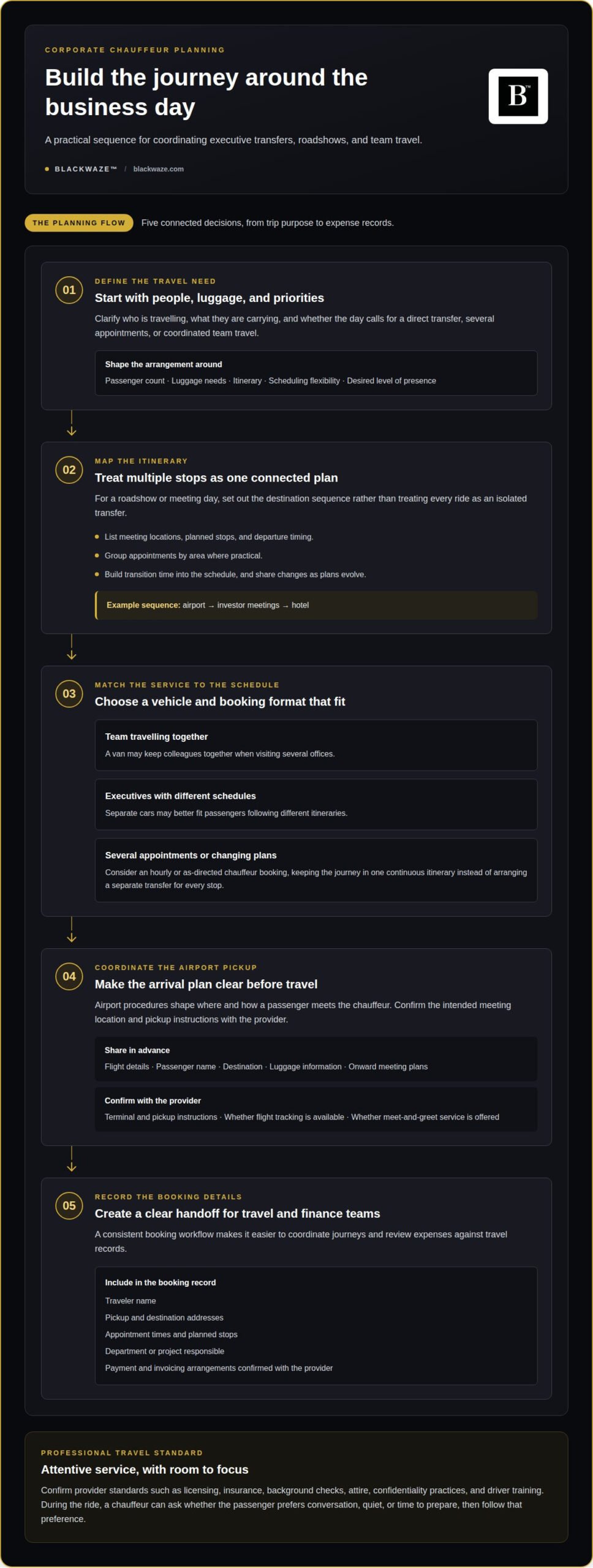
Reliability also depends on clear itinerary details. Share the pickup address, appointment location, and planned stops when arranging service. A chauffeur can plan around the destination sequence instead of treating each ride as an isolated transfer. The final 30 minutes before a presentation can serve as valuable preparation time, making a calm, coordinated ride useful.
Hourly and As-Directed Service
Hourly Charters / As-Directed Chauffeur Service keeps a chauffeur with the passenger between appointments. It suits executives with several meetings, changing departure times, or stops across a business district. Rather than arranging separate transfers for every destination, you can plan the itinerary as one continuous booking and communicate adjustments as plans evolve.
For example, a business day might begin at a hotel, continue to a client meeting, then move to another office for an afternoon appointment. Provide the planned stops and timing when arranging the service, then communicate any changes. A dedicated chauffeur handles the driving and route transitions, making this format useful when the time spent at each destination may shift.
Etiquette and Confidentiality
Executive etiquette is attentive without being intrusive. A chauffeur can ask whether a passenger prefers conversation, quiet, or time to prepare, then follow that preference. A brief greeting, luggage assistance, and a smooth departure can set a composed tone for the journey.
Confidentiality is equally important during business travel. Treating everything heard in the vehicle as confidential is a sound professional standard, particularly when executives discuss meetings, clients, or internal plans. Passengers can use the ride to review presentation materials or speak discreetly. Executive privacy and chauffeur etiquette help shape a professional travel experience.
Airport Pickup Coordination
Airport pickup arrangements should account for the flight, terminal, and pickup instructions. Ask the provider whether flight tracking is available to help coordinate the arrival plan. Meet-and-greet service can add a clear meeting point, helping the passenger connect with the chauffeur after landing. The pickup process follows the airport’s procedures, so the itinerary should identify the intended meeting location.
For a business arrival, provide the flight details, passenger name, and destination before travel. Confirm how the provider handles flight updates, while clear information about luggage and onward meetings supports a smooth transfer from airport to destination.
Corporate transportation for executives, roadshows, and teams
Executive car services are prearranged, chauffeur-driven journeys planned around a business schedule. Unlike rideshares or taxis, BLACKWAZE™ is a premium private chauffeur service, not an on-demand dispatch or street-hail option. A chauffeured limousine describes a vehicle or service style; corporate transportation coordinates journeys around passenger needs and business plans.
Luxury business ground transportation can include airport transfers, point-to-point trips, hourly bookings, and coordinated group journeys. A roadshow itinerary might connect an airport, several investor meetings, and a hotel. Planning the sequence together helps align pickups and transfers with the working schedule.
Coordinate Roadshows and Team Travel
A roadshow plan should account for meeting locations, passenger changes, and schedule priorities. A travel coordinator can group appointments by area, identify which executives need individual vehicles, and share the stop sequence. For a team visiting several offices, a van may keep colleagues together; separate cars may better fit executives following different schedules.
Congestion can make an executive miss a meeting or disrupt the next transfer. Build reasonable transition time into the itinerary and provide clear pickup instructions. For an international roadshow, put each destination, meeting address, passenger, and planned departure in one itinerary. Ask BLACKWAZE™ about arranging transportation for a multi-stop business schedule.
Manage Bookings and Expense Reporting
A consistent booking workflow gives corporate travel teams a clearer record of each journey. Include the traveler’s name, pickup and destination addresses, appointment times, and the department or project responsible. Saving frequent locations and passenger preferences can simplify repeat reservations and reduce repeated data entry.
Before booking, confirm the available payment and invoicing arrangements with the transportation provider, so finance teams can reconcile expenses against travel records. Organizations may also wish to establish a process for recording bookings across cities or departments. A documented roadshow itinerary can help a coordinator track transfers and review charges after travel.
Choose for Reliability and Employee Safety
When selecting a service, ask about chauffeur qualifications, insurance, vehicle standards, and how itinerary changes are handled. Review the provider’s policies and procedures, and confirm any requirements that matter to your organization before booking. These are practical criteria for assessing executive transportation.
Employee safety planning starts with accurate passenger and pickup information. A coordinator can share the itinerary with each traveler, confirm the agreed meeting point, and record who is expected at each destination. For an employee leaving a late meeting, precise pickup instructions can reduce uncertainty about the arranged journey.
Set Standards for Corporate Travel
Corporate travel managers can evaluate reliability through punctuality records, service feedback, and consistent trip documentation. Establishing a clear process for recurring bookings and itinerary adjustments can help coordinators manage changes. Reviewing payment records gives an organization a clearer view of travel activity, particularly when executives have overlapping schedules or several departments arrange transportation.
For companies arranging luxury business ground transportation, written booking standards can bring consistency to trip details, expense records, and passenger communication. Set a shared process for submitting itineraries and recording changes, so travelers and coordinators work from the same plan. For an upcoming roadshow or team itinerary, arrange corporate transportation online with passenger, stop, and schedule details.
Business-class and first-class vehicle options
Vehicle choice shapes comfort, space, and the impression an executive journey creates. A Mercedes-Benz S-Class suits an individual executive, while a Cadillac Escalade may better fit a group.
Vehicle Types and Passenger Capacities
Passenger count is a useful starting point, but luggage and seating needs matter too. Luxury sedans are listed for 1-3 passengers, while full-size SUVs are listed for 3-6. Executive Sprinter vans are listed for 6-12 passengers. A Cadillac Escalade ESV seats up to seven passengers, making it an option for a larger party.
For example, an executive traveling alone with a briefcase may prefer a sedan. A small team with presentation cases may need more cabin and luggage space. Match the vehicle to the actual party and baggage, rather than choosing solely by passenger capacity.
Fleet Availability
BLACKWAZE™ offers a late-model luxury fleet for different business journeys, including executive sedans, premium SUVs, Mercedes-Maybach vehicles, and Mercedes Sprinter executive vans. Every vehicle is daily detailed and includes chilled water, Wi-Fi, and other complimentary amenities. Choose based on the itinerary, passenger count, and luggage.
Vehicle variety can help a fleet suit different corporate itineraries. BLACKWAZE™ offers executive sedans, premium SUVs, luxury Sprinter vans, and stretch limousines, with city-specific availability for the latter. Consider passenger count, luggage, itinerary, and the level of presence required, not just the vehicle’s appearance.
Vehicle Inspections and Driver Screening
Vehicle condition and chauffeur standards are central to a professional journey. BLACKWAZE™ vehicles are late-model and daily detailed. Its chauffeurs are background-checked, suit-clad, NDA-signed, and trained in defensive driving, etiquette, and discretion. These standards matter when corporate teams assess a transportation service.
For instance, a travel manager arranging an airport-to-boardroom transfer needs a clean, prepared vehicle and a qualified chauffeur. BLACKWAZE™ vehicles are daily detailed, and its chauffeurs are trained in defensive driving and discretion. Flight tracking and clear route details help coordinate the journey with the schedule.
Matching Business-Class and First-Class Options
“Business-class” and “first-class” can describe different service levels, so labels alone do not show what a journey includes. Consider vehicle category, passenger and luggage space, chauffeur service, and trip format. A Mercedes-Benz S-Class may suit a private executive transfer; a van may be more practical for colleagues traveling together.
For a roadshow, the itinerary may call for several stops and space for work materials. An airport transfer may prioritize luggage capacity and a direct route. Select the vehicle for the actual journey, considering comfort, traffic exposure, and schedule rather than relying on prestige labels alone.
Executive sedans, SUVs, vans, shuttles, and buses
Executive and corporate travel options include sedans, SUVs, passenger vans, and VIP vehicles. An executive Sprinter van can suit colleagues traveling together, while a sedan may fit an individual transfer. Stretch limousines, shuttles, and buses serve different occasions and group arrangements, so choose based on the journey, passenger needs, and intended level of privacy.
Vehicle selection can support a company’s travel objectives. One executive traveling between an airport and a client meeting may value a quiet sedan. A team carrying presentation materials may need more passenger and luggage space. Matching the vehicle to the trip can ease coordination and help employees arrive prepared, making transportation a considered part of business travel planning.
Begin with the passenger profile and itinerary. Note who is traveling, how much luggage or work equipment they have, and whether they need separate pickups. A Cadillac Escalade, for example, may be appropriate for a small group seeking an executive SUV, while a Mercedes-Benz S-Class suits a private executive transfer. The right fit depends on actual seating and luggage requirements.
A Sprinter van offers a distinct format for group travel. It can keep colleagues together between an airport, hotel, and meeting venue, simplifying shared arrival coordination. A stretch limousine has a different profile, often associated with formal events or VIP occasions. For business itineraries, assess whether its layout supports the passengers’ practical needs, including entering and exiting at each destination.
Shuttles and buses are group transportation formats, not private chauffeured vehicles. A shared shuttle typically follows a common route or passenger arrangement, while a private corporate vehicle is scheduled for a particular party or itinerary. A bus can move a larger event group, but may not suit a client visit requiring discretion or direct, individual pickups.
Airport transfers make vehicle fit especially visible. A traveler arriving with luggage needs suitable space, while colleagues landing together may benefit from one coordinated pickup. For a corporate event, map pickup points, destinations, passenger groups, and departure times before assigning vehicle types. This helps avoid a mismatch between the schedule and selected transport.
Consider the full journey, not just the vehicle’s exterior. Weigh passenger count, luggage, itinerary complexity, privacy, and the impression required at each destination. A sedan may suit an executive with an individual meeting schedule; a van can support a team moving between venues. Let the trip profile guide the choice.
Luxury sedans versus full-size SUVs
A luxury sedan suits an individual executive or smaller party, while a full-size SUV offers more passenger and luggage capacity. Luxury sedans are listed for 1-3 passengers, and full-size SUVs for 3-6. The practical choice depends on the passenger count, bags, itinerary, and desired vehicle profile. Neither option is automatically the better business car service.
For an executive traveling alone from an airport to a meeting, a sedan can provide a composed, discreet setting. It presents a formal profile and works well when the passenger has limited luggage. A Mercedes-Benz S-Class is one example of a premium sedan. Consider the complete itinerary, including whether the passenger will travel directly or make several business stops.
A full-size SUV is useful when the journey involves several passengers or more luggage. A group arriving on the same flight may prefer one dedicated vehicle instead of coordinating separate pickups. Added space can also accommodate work materials. For example, colleagues traveling from an airport to a hotel can remain together before continuing to meetings.
Comfort depends on more than the vehicle category. Consider how many people will ride, the amount of luggage, the journey length, and whether passengers need room to work. A sedan may suit an individual traveler; an SUV may suit colleagues sharing a journey. Share flight details, passenger count, and destination when booking.
Pickup conditions and traffic can affect a journey, especially around busy airports and business districts. A sedan can suit a direct airport transfer or an executive’s individual schedule. An SUV can better accommodate a group with bags or equipment. For a roadshow, consider passenger needs and planned stops, rather than choosing only for the first pickup.
Use a straightforward decision rule: choose a sedan for an individual traveler or smaller party with modest luggage; choose an SUV when the group or bags need more room. If passenger numbers approach capacity, account for luggage and comfort in the booking details. This helps match the vehicle to the journey, not just the passenger limit.
For an executive airport transfer or business itinerary, book the vehicle that fits your journey.
BLACKWAZE™: Hotel, airport, business, event, and leisure transfers
BLACKWAZE™ provides private chauffeur transportation for hotel, airport, business, event, and leisure journeys. Arrange an airport transfer in advance and share your pickup details, flight information, and luggage needs when booking. For trips with multiple stops, provide your destinations and schedule so the transportation arrangement can be tailored to your itinerary.
Choose the arrangement around your schedule. A direct airport journey calls for an airport transfer; meetings across several destinations may require transportation between planned locations. For an event or leisure itinerary, a private chauffeur provides a dedicated journey between planned locations. Share your pickup, destinations, timing, passenger details, and luggage needs when booking.
For a private chauffeur journey tailored to your itinerary, contact BLACKWAZE™ to arrange transportation.
Plan Your Next Business Journey with Intention
Strong travel planning begins before the first pickup. Treat transportation as part of the itinerary, alongside meetings, flight details, and each traveler’s priorities. A considered approach to luxury business ground transportation can help executives and teams transition more smoothly between commitments, without adding unnecessary complexity to the schedule.
When arranging business transportation, consider the pickup details, destinations, and schedule. These details can help you determine the type of service that best fits the journey.
Choose the arrangement that fits your next trip, whether it involves one executive, a sequence of meetings, or travel between business destinations. Plan your ride with BLACKWAZE™ and move into your next commitment with a clear transportation plan.
Frequently Asked Questions
Are your chauffeurs licensed and background-checked?
Yes. BLACKWAZE™ chauffeurs are licensed, commercially insured, background-checked, suit-clad, NDA-signed, and trained in defensive driving, etiquette, and discretion. For a corporate travel file, retain relevant credential and insurance details alongside the itinerary. This creates a clear record of the transportation arrangement and helps align internal procedures with the professional standards expected for executive journeys.
Can you handle last-minute or emergency transportation bookings?
BLACKWAZE™ is a pre-arranged chauffeur service, not emergency transportation. For urgent, non-emergency travel, submit the trip details through the booking channel. Support is available 24/7, but a reservation requires arrangements for the requested journey. For medical emergencies, contact emergency services. Providing the pickup, destination, passenger, and timing information helps the reservation team understand the request without implying instant dispatch or guaranteed availability.
Do you provide airport transfers?
Yes. BLACKWAZE™ provides airport transfers with flight tracking, meet-and-greet, and free wait time included. Enter the airport and flight details when booking, along with the passenger’s name and onward destination. If the traveler is continuing to a hotel or business appointment, include that destination in the reservation. Clear arrival information helps organize the pickup around the flight and the passenger’s onward plans.
How do you choose the right executive transportation partner?
Choose a partner whose chauffeur credentials, commercial insurance, booking process, and billing approach suit your travel program. For recurring executive trips, consider how the service handles passenger preferences, itinerary changes, and travel records. A company arranging a roadshow, for example, may need coordinated reservations across several destinations. Clear booking details and a defined point of contact help travel teams manage schedules and communicate changes effectively.
How many passengers can your vehicles accommodate?
BLACKWAZE™ vehicle capacities depend on the model: Mercedes-Benz S-Class and Mercedes-Maybach S-Class accommodate up to 2 passengers; Cadillac Escalade and Range Rover accommodate up to 5; Mercedes Sprinter executive vans accommodate 7-12 passengers. Include luggage and work materials in the vehicle choice, not just passenger count. A traveler carrying presentation cases, for example, may need more room than someone with a small personal bag.
How much does corporate luxury ground transportation cost in the United States?
BLACKWAZE™ provides an upfront quote with an all-inclusive fixed fare for the requested journey. The fare reflects the itinerary and selected service, including the vehicle, route, booking format, and trip details. Extra stops or extended waiting are quoted separately. Share the transportation requirements through the booking process to receive pricing for that specific arrangement, rather than relying on a general estimate that may not fit the itinerary.
How does a professional provider book and manage ground transportation for business travelers?
BLACKWAZE™ accepts reservations through its website booking widget and mobile app. Provide the passenger’s name, pickup, destination, schedule, and flight information when relevant. For a journey with multiple appointments, submit the full itinerary so each leg can be arranged in context. The booking details create a shared reference for the traveler and coordinator, while flight tracking supports airport arrival planning when the reservation includes an air transfer.
What safety, licensing, insurance, and driver-vetting standards should companies check?
Companies should consider licensing, commercial insurance, background screening, and vehicle safety checks when reviewing transportation standards. BLACKWAZE™ chauffeurs are licensed, commercially insured, background-checked, suit-clad, NDA-signed, and trained in defensive driving, etiquette, and discretion. Corporate travel teams can keep the relevant service credentials with vendor records and note how passenger information is handled. These steps support a consistent assessment of operational and professional standards.

