


What makes a luxury fleet for corporate travel useful is not a row of identical premium cars. It is having the right vehicle and service arrangement for each journey.
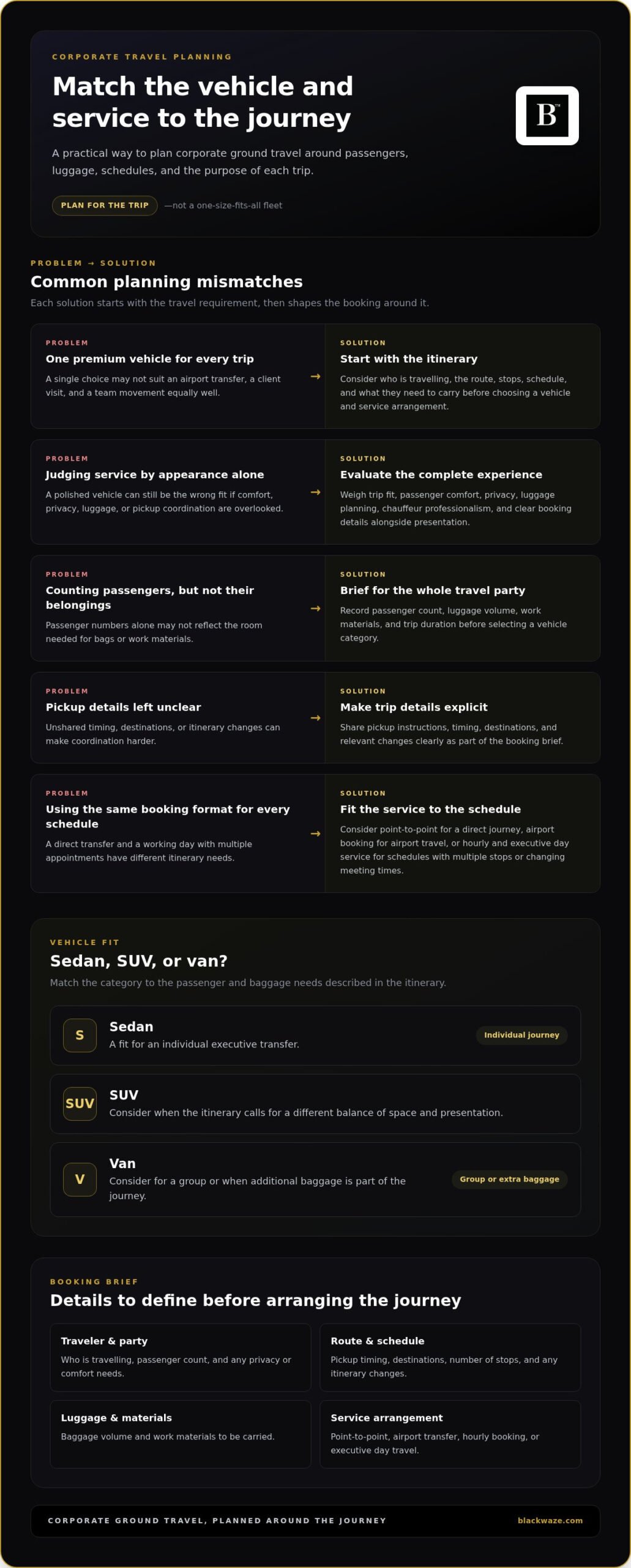
Comfort and professional presentation matter, but they cannot make up for a vehicle with too little room for luggage or unclear pickup arrangements. Start with how employees and guests will travel: a sedan for an individual executive transfer, an SUV when the itinerary calls for a different balance of space and presentation, or a van for a group or additional baggage. Then account for airport pickups, consecutive meetings, and travel between destinations.
Choosing the right arrangement means looking beyond vehicle class. Chauffeur professionalism, privacy, booking coordination, and clear trip details all shape the experience. A company does not need to own vehicles to arrange business transportation. Pre-arranged chauffeur services can support different itineraries with point-to-point transfers, airport bookings, hourly service, and executive day travel.
This guide explains how to match vehicle categories to passenger and luggage needs, set clear expectations for a journey, and select a service arrangement that fits a business schedule. Use it to create a practical process for planning comfortable, polished, and consistent corporate ground travel.
Key Takeaways
- Build a luxury fleet for corporate travel around actual itineraries, not a one-size-fits-all vehicle choice.
- Evaluate comfort, privacy, luggage capacity, chauffeur professionalism, and booking clarity alongside presentation.
- Match sedans, SUVs, or vans to passenger numbers, baggage, and the purpose of each journey.
- Document traveler, timing, and itinerary needs before arranging corporate chauffeur transportation.
- Use flexible chauffeured services to coordinate airport transfers, point-to-point journeys, hourly bookings, and executive day travel.
Why a Luxury Fleet for Corporate Travel Must Fit the Journey
A luxury fleet for corporate travel is a selection of vehicle options and service standards organized around a company’s business journeys, rather than one premium vehicle used for every trip. A suitable arrangement accounts for who is travelling, where they need to go, how many stops the itinerary includes, and what they need to carry. The vehicle matters, as do the chauffeur, booking details, privacy, and coordination.
Different journeys call for different planning. An airport transfer may involve flight timing and luggage. An executive meeting may call for a composed arrival and a quiet setting between appointments. A client visit can place more emphasis on a polished first impression, while a team movement may need more seats and room for work materials. Premium transportation is about the suitability of the complete service, not simply the status of the vehicle.
These choices also fit within a company’s wider travel policy. Corporate travel management encompasses how organizations plan employee journeys and manage travel arrangements. Ground transportation is one part of that framework. Clear standards help align traveler needs, schedules, and presentation across different business trips.
Which corporate journeys call for chauffeured transportation?
Pre-arranged chauffeur service can support airport transfers, executive meetings, client visits, business events, and itineraries with several appointments. For a direct trip between two locations, point-to-point service may suit the schedule. When a traveler needs transportation across a working day, with multiple stops or changing meeting times, an hourly booking or executive day service may be a better fit.
Consider the traveler as well as the route. Privacy may give an executive space to prepare or handle a confidential conversation. A comfortable transfer between an airport, hotel, and office can make a demanding travel day easier to manage. A professional arrival can matter when greeting a client or attending an event. These are practical requirements to include in the booking brief, not decorative extras.
Fleet ownership versus arranging chauffeured transportation
Owning company vehicles means maintaining and coordinating them as organizational assets. Arranging chauffeur-driven journeys instead lets a company plan transportation for specific itineraries without making every trip a fleet ownership decision. This approach can accommodate different needs with vehicle categories such as sedans, SUVs, and vans, matched to the journey rather than assigned uniformly.
For example, an individual executive’s airport transfer may call for a sedan, while a group travelling with additional luggage may need another category. BLACKWAZE™ provides chauffeur-driven corporate transportation, including point-to-point journeys, airport transfers, hourly bookings, and executive day chauffeur service. Companies can explore its chauffeur vehicle categories as part of their planning. The guide Luxury Ground Transportation: How Chauffeur-Driven Travel Works offers further context on arranging these journeys.
The principle is straightforward: define the travel requirement first, then select the vehicle and service arrangement that support it. This connects professional presentation to the actual needs of the trip.
How to Evaluate a Luxury Corporate Fleet Beyond Appearance
A polished exterior is only the first impression. To evaluate a luxury corporate fleet, consider whether the vehicle and service support the itinerary, traveler, and business purpose. A premium vehicle can still be the wrong choice if passengers are crowded, luggage leaves no room for work materials, or the pickup details are unclear.
Vehicle quality alone does not define corporate service quality. The full experience depends on trip fit, passenger comfort, privacy, luggage planning, chauffeur professionalism, and clear coordination. Use these criteria to separate the requirements that apply to every booking from preferences that matter only for particular occasions.
- Trip fit: Check that the vehicle and service arrangement suit the route, schedule, and number of stops.
- Passenger comfort: Consider journey duration and whether travelers need a composed setting between appointments.
- Privacy: Identify whether the traveler needs discretion or space to focus during the journey.
- Luggage: Account for bags and work materials, not just the passenger count.
- Professional standards: Set expectations for chauffeur conduct, presentation, and awareness of the itinerary.
- Booking clarity: Share pickup details, timing, destinations, and any relevant changes clearly.
Separate baseline standards from occasion-specific preferences. Clear pickup instructions and professional conduct may be expected for every booking. A particular vehicle style or additional space may matter more for a client visit, event, or longer itinerary. This distinction helps travel planners apply a consistent standard without treating every journey as identical.
Match vehicle capacity to passengers and luggage
Plan around the whole travel party. Before choosing a category, record the passenger count, luggage volume, work materials, and trip duration. A sedan may suit one executive travelling with limited baggage, yet be less appropriate for a small delegation carrying presentation cases. Count the bags and consider their size, then match the vehicle to the specific itinerary rather than relying on a general assumption about capacity.
Assess discretion, comfort, and professional presentation
A calm, private setting can give executives room to prepare, take calls, or travel between meetings with fewer distractions. Professional presentation also shapes how employees, clients, and visiting guests experience the journey. Treat chauffeur communication, discretion, and attention to the planned itinerary as part of the service standard, not as separate from the vehicle.
BLACKWAZE™ provides premium chauffeur-driven transportation across sedan, SUV, van, and VIP vehicle categories. Reviewing the BLACKWAZE™ fleet categories can help corporate planners understand the available vehicle types when aligning a journey with passenger and luggage needs.
Before arranging transportation, prepare the passenger, baggage, timing, privacy, and destination details. BLACKWAZE™ bookings can be arranged online, making it straightforward to submit trip information in one place. Arrange a chauffeur booking around the requirements of the journey.
Sedan, SUV, or Van: Compare Corporate Vehicle Options
Vehicle class should follow the itinerary, not a fixed idea of what looks most prestigious. A sedan can suit an individual executive on a direct business journey. An SUV offers a different balance of space and presentation, while a van can be practical for a team or additional luggage. Choose a vehicle class according to the passengers, baggage, and schedule each itinerary requires.
Use this comparison as a starting point. Suitability depends on the specific vehicle and journey details, so include luggage and work materials in the decision rather than counting passengers alone.
| Vehicle class | Suitable journey | Planning considerations |
|---|---|---|
| Sedan | Individual executive travel or a compact travel party | Consider passenger count, luggage, and whether a direct, polished arrival is the priority. |
| SUV | Journeys where travelers need a different balance of space and executive presentation | Account for the party’s baggage and any work materials alongside the number of passengers. |
| Van | Team movements or trips involving additional luggage | Plan around the group, itinerary, and items travelling with them, rather than choosing by passenger count alone. |
When arranging a luxury fleet for corporate travel through a chauffeur service, this distinction makes it easier to select transport for each booking instead of defaulting to one category. A Mercedes-Benz S-Class or Maybach is an example of a VIP sedan, while a Cadillac Escalade is an example of a VIP SUV. These are examples of vehicle types, and the right category depends on the specific journey.
When does a sedan suit executive travel?
A sedan is worth considering for an individual executive or compact travel party travelling directly to a meeting, hotel, or airport. Its understated profile can support a polished arrival without making vehicle size the focus. First, consider whether the passenger arrangement and luggage will fit the specific sedan. A short journey with light baggage calls for different planning than an airport transfer with several bags.
When should companies consider SUVs or vans?
An SUV may suit travelers who need a different balance of space and refined presentation. A van is worth considering when colleagues travel together or luggage takes up more room. In either case, map the whole journey: a group moving between meetings may have different requirements from the same travelers heading directly to an event with bags and presentation materials.
Corporate planners can explore BLACKWAZE™ corporate chauffeur transportation for pre-arranged journeys suited to executive, airport, and business travel. BLACKWAZE™ provides chauffeur-driven transportation across sedan, SUV, and van categories, with services including point-to-point trips, airport transfers, hourly bookings, and executive day chauffeur service. The useful comparison is not simply which class looks most elevated. It is which one supports the passengers, luggage, and itinerary with the right balance of comfort and presentation.
A Practical Checklist for Selecting Corporate Chauffeur Transportation
A clear booking brief turns vehicle selection into a repeatable process. It gives travel planners a consistent way to match transportation to each journey without assuming every employee, guest, or itinerary has the same requirements. Use this sequence before arranging a chauffeur.
- Map the journey. Record the trip purpose, pickup and drop-off points, stops, schedule, and whether the traveler is arriving by air. Note which details are fixed and where the itinerary may change.
- Identify traveler needs. Document passenger count, luggage, work materials, privacy needs, accessibility considerations, and presentation preferences relevant to the occasion. Keep essential requirements distinct from preferences.
- Select the vehicle category. Match the passenger party and baggage to a sedan, SUV, or van based on the specific trip. Choose according to practical needs, not appearance alone.
- Choose the service arrangement. Use point-to-point booking for a defined transfer. Consider hourly service when the schedule includes several stops or may shift, an airport transfer for airport travel, or executive day chauffeur service for transportation across a business day.
- Finalize booking details. Share the itinerary, timing, passenger and luggage requirements, and relevant preferences together. Clear information helps align the transportation arrangement with the plan.
Build a concise corporate travel brief
A useful brief is specific to the journey, not a standing assumption about a traveler. Include the business purpose, pickup and drop-off details, planned stops, schedule, passenger needs, and luggage. Flag privacy, accessibility, or presentation preferences when they matter to that itinerary. A visiting client’s direct transfer, for example, may call for different arrangements than a team’s multi-stop meeting day.
Compare service arrangements against the itinerary
Let the schedule guide the booking format. A direct transfer has a clear origin and destination; an hourly booking can suit a sequence of appointments. An airport transfer is intended for airport travel, while an executive day chauffeur can support transportation across a working day. BLACKWAZE™ offers these service options for corporate journeys, with booking available through its website and mobile app.
Companies can keep a brief template and tailor it for each traveler and trip. That makes it easier to capture practical details, select an appropriate vehicle category, and communicate expectations clearly, without turning one preference into a blanket rule for every employee.
How BLACKWAZE™ Supports a Flexible Luxury Fleet for Corporate Travel
BLACKWAZE™ provides chauffeur-driven transportation for business journeys. Rather than requiring a company to own vehicles, corporate clients can arrange transportation for particular itineraries, with the vehicle category and service type shaped around the trip. This gives planners a practical way to organize executive and guest travel around each journey’s needs.
Vehicle categories include sedans, SUVs, vans, and VIP vehicles such as the Mercedes-Benz S-Class, Maybach, Cadillac Escalade, or comparable executive vehicles. The appropriate choice depends on the journey, including who is travelling and what the itinerary involves. BLACKWAZE™ also supports multi-city and international chauffeur transportation through its professional affiliate network, with 24/7 support.
Choose a service arrangement around the business itinerary
Match the booking to the shape of the day. An airport transfer covers airport travel, while point-to-point service suits a defined journey between locations. Hourly bookings for a private chauffeur for day trips can accommodate a sequence of appointments, and executive day chauffeur service can support transportation across a working day. The passenger’s needs and planned schedule help determine which arrangement is appropriate.
BLACKWAZE™ provides corporate chauffeur transportation for business travel. Travel planners can use the itinerary to guide the service choice, then share the relevant trip details when arranging transportation.
Arrange a corporate journey with BLACKWAZE™
For a well-structured request, bring together pickup and drop-off points, timing, planned stops, passenger details, and luggage requirements. Include preferences that affect the journey, such as privacy or presentation, along with scheduling considerations. A clear brief gives the transportation plan a useful foundation and helps align the request with the traveler’s needs.
BLACKWAZE™ provides professional chauffeurs and premium vehicles for planned business journeys. Its support team is available around the clock, and its affiliate network supports multi-city and international itineraries. Providing clear trip information helps keep each booking focused on its specific purpose.
Put your company’s travel plan into motion with private corporate transportation arranged around the journey.
Make Your Next Business Journey More Deliberate
A thoughtful transportation policy does not need to prescribe the same arrangement for every trip. It can set clear expectations while leaving room to respond to the traveler, itinerary, and purpose. Start with the journeys your team has coming up, then make the important details easy to communicate and arrange.
This practical approach turns a luxury fleet for corporate travel from a vehicle preference into a considered part of the employee and guest experience. Each booking can support a composed arrival, a well-planned schedule, and a comfortable journey when the vehicle and service fit the traveler’s needs.
When you are ready to put those requirements into practice, arrange private corporate transportation with BLACKWAZE™. A clear itinerary is a confident first step toward travel that reflects your company’s standards.
Frequently Asked Questions
Does a company need to own a luxury fleet for corporate travel?
No. A company can arrange premium transportation without purchasing vehicles. To organize a luxury fleet for corporate travel through chauffeur bookings, planners can establish booking guidelines, approval steps, and a process for communicating itinerary changes. This approach can be useful when travel demand varies or employees travel for different purposes. Reviewing the guidelines periodically helps keep them practical as the company’s travel programme evolves.
Can one vehicle type serve every corporate travel need?
Sometimes, but a single default can leave important exceptions unaddressed. A company can define a preferred option for routine bookings while setting out when employees should request a different category. Keep the guidance simple enough for employees and travel coordinators to apply consistently. Reviewing booking patterns and traveler feedback can help determine whether the policy remains useful without requiring every trip to follow an identical template.
How should a company choose a vehicle for executives and visiting clients?
Set a consistent standard for the experience the company wants to provide, then let the booking reflect the occasion. For a visiting client, clear arrival instructions and a polished, discreet experience may be priorities; an executive’s recurring journey may call for a different emphasis. Shared guidance for assistants and travel coordinators can support a considered presentation without treating a particular vehicle as a status requirement.
What information should a company provide when arranging a chauffeured journey?
Share the journey details and clarify who is authorized to arrange or amend the booking. Provide relevant internal billing or approval references, and make sure the traveler understands the pickup arrangement. If plans change, a named company contact and a clear update process can reduce confusion for both the traveler and coordinator.
Are luxury chauffeur services suitable for both airport transfers and business meetings?
Yes. Chauffeur services can support airport journeys and transportation connected with meetings. For a travel day combining an air arrival, hotel check-in, and appointments, consider how each leg fits the traveler’s working schedule and who is coordinating it. A company can use a consistent booking and communication process while letting each arrangement reflect the purpose of the journey.
What is the difference between a corporate chauffeur service and a company vehicle fleet?
The difference is how the company organizes transportation. With company vehicles, the business manages its own transportation assets and related administration. With a chauffeur service, it arranges professional transportation for planned journeys. A travel policy can clarify which approach applies to different business situations, who approves bookings, and how employees should follow the process.

